
Tow Dolly vs Auto Transport: Honest 2026 Comparison
Published by A4 Auto Transport | Auto Transport Research & Consumer Education
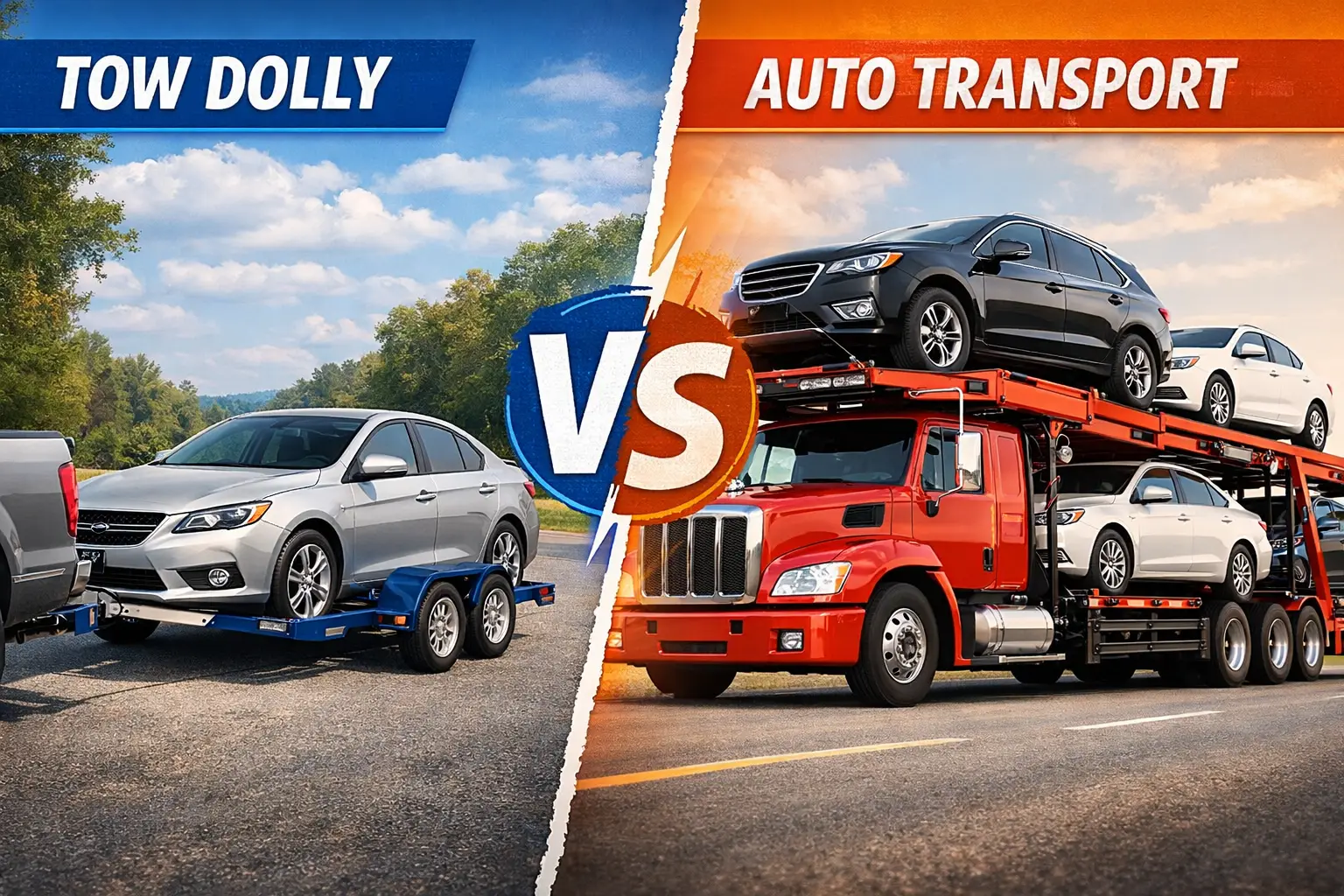
A tow dolly lifts your car’s front wheels off the ground and lets the rear wheels roll on the road behind a rental truck you drive yourself. Professional auto transport loads your entire vehicle onto a carrier, all four wheels off the ground, and a licensed driver delivers it while you travel separately.
That mechanical difference is what everything else in this comparison flows from: cost, compatibility, wear, safety, and the scenarios where one option clearly outperforms the other. A tow dolly is cheaper to rent, but it requires a tow-capable vehicle, & puts real road miles on your rear wheels. Professional auto transport costs more upfront, adds zero miles to your vehicle, works with any drivetrain, and removes you from the equation entirely.
The cheapest option on paper is rarely the cheapest option in practice. That tension, and where it breaks in each direction, is what this guide actually resolves.
What Is Tow Dolly?
A tow dolly is a two-wheel trailer that raises a vehicle’s front axle off the ground while its rear wheels remain in contact with the road. The towed car is strapped to the dolly’s cradle and pulled by a separate vehicle, typically a rental truck, via a hitch receiver. The rear wheels roll the full distance of the trip, accumulating real mileage, tire wear, and brake stress.
That last point is not just a footnote. On a 1,000-mile move, the rear wheels of your towed vehicle travel 1,000 miles with no lubrication cycling, no engine running, and no driver attention. For a vehicle close to a tire replacement interval or with aging wheel bearings, this is a meaningful mechanical exposure.
What Is Professional Auto Transport?
A professional auto transport carrier loads your vehicle fully onto an open or enclosed trailer, raising all four wheels off the ground. A licensed, FMCSA-registered driver operates the carrier and delivers the vehicle to the specified destination. Your odometer does not move. Your tires do not rotate. Your drivetrain sits idle for the entire journey.
Open auto transport is the standard for most shipments and carries multiple vehicles simultaneously, which keeps costs lower. Enclosed carriers provide full weather and road debris protection, making them the preferred method for classic cars, luxury vehicles, and low-clearance performance cars. Professional transport accommodates virtually any vehicle type including AWD, RWD, 4WD, non-running, convertible, or oversized, without requiring any mechanical preparation from the owner.
How to Tow a Car with a Tow Dolly
The loading process is more involved than most renters expect. Each step carries real consequences if skipped or done incorrectly.
Step 1: Confirm Compatibility
Verify your vehicle is FWD, or arrange driveshaft removal for RWD. Check the dolly’s weight capacity against your vehicle’s curb weight. The tow vehicle must weigh at least 750 lbs more than the car being towed and must have a rated hitch receiver installed.
Step 2: Drive the Front Wheels On
Back the tow vehicle to align the dolly, then slowly drive the towed car’s front wheels onto the cradle until fully seated. Keep the transmission in neutral and the steering wheel unlocked. Check front clearance for low-profile vehicles before proceeding.
Step 3: Secure the Wheel Straps
Route the ratchet straps over each front tire and tighten to manufacturer-specified tension. Undertightened straps allow load shift and sway. Recheck strap tension after the first 50 miles once the vehicle has settled.
Step 4: Attach Safety Chains and Test Lights
Cross the safety chains under the dolly tongue and connect to the hitch in an X-pattern as a backup coupling. Wire the dolly’s brake and turn signal lights into the tow vehicle’s system and confirm all lights are working before departure.
Step 5: Set the Towed Vehicle Correctly
Transmission in park (automatic) or first gear (manual), parking brake released, steering column locked straight ahead. An engaged parking brake on rear wheels rolling at highway speed causes flat spots and bearing damage.
Step 6: Drive Within Safe Limits
Do not exceed 55 mph. Double your following distance. If the rig begins to sway, do not brake hard. Accelerate slightly, hold the steering straight, then reduce speed gradually. Inspect strap tension and check rear tire temperature at rest stops.
How to Ship a Car with a Professional Auto Transport Service
Professional transport removes operational responsibility from the owner, but a few preparation steps protect your rights if a dispute arises.
Step 1: Get Quotes and Verify FMCSA Credentials
Request quotes from multiple carriers or brokers. Confirm each carrier holds valid FMCSA authority by checking their MC number at safer.fmcsa.dot.gov. Verify active cargo insurance, not just liability coverage.
Step 2: Choose Open or Enclosed Transport
Open carriers cost less due to multi-vehicle loads and handle most standard shipments. Enclosed carriers protect against weather and road debris during transit. Choose enclosed for classic, luxury, or low-clearance vehicles where finish condition matters.
Step 3: Prepare the Vehicle
Remove all personal belongings since transport contracts typically exclude coverage for items inside the car. Photograph every panel, glass surface, and the undercarriage before pickup to establish a condition baseline.
Step 4: Complete the Bill of Lading at Pickup
Walk the vehicle with the driver and confirm every pre-existing scratch or dent is noted on the bill of lading before signing. Never sign a blank or incomplete form. This document determines whether any damage found at delivery is valid for a claim.
Step 5: Inspect at Delivery Before Signing
Inspect every panel under adequate lighting before signing the delivery paperwork. Note any new damage in writing on the delivery bill of lading before the driver departs. Once signed without notation, the claim window closes.
Key Differences Between a Tow Dolly and Auto Transport
The mechanical distinction between the two methods drives practical differences across every factor that matters: vehicle condition during transit, who is responsible, total cost, and which vehicles qualify for each method.
| Difference | Tow Dolly | Auto Transport |
|---|---|---|
| How Vehicle Is Carried | Front wheels lifted, rear wheels roll on road | All four wheels fully off the ground |
| Who Operates It | Owner drives, loads, and manages the trip | Licensed carrier driver handles everything |
| Drivetrain Exposure | Rear wheels, bearings, and brakes accumulate mileage | Zero drivetrain movement during transit |
| Vehicle Compatibility | Primarily FWD; RWD and AWD require driveshaft removal | All drivetrain types including AWD, 4WD, non-running |
| Odometer Impact | Rear wheels accumulate full trip mileage | No miles added to the vehicle |
| Speed Restriction | 55 mph max; some states add further restrictions | No speed restriction on the carrier vehicle |
| Convertibles and Soft-Tops | Not permitted | Permitted via enclosed transport |
| Non-Running Vehicles | Not compatible; requires a driveable car | Compatible via winch loading |
| Insurance Structure | Optional rental waiver; personal policy gaps common | FMCSA cargo insurance; bill of lading creates claim baseline |
| Driver Experience Needed | Significant towing knowledge required | None required from the owner |
| Typical Cost Range | $100 to $300+ fully costed (dolly, truck, fuel, insurance) | $625 to $1,200+ depending on distance and carrier type |
Tow Dolly vs Auto Transport: Vehicle Compatibility
| Factor | Tow Dolly (DIY) | Professional Auto Transport |
|---|---|---|
| Vehicle Position | Front wheels lifted, rear wheels on road | All four wheels fully off ground |
| Who Drives | You (DIY) | Licensed carrier driver |
| Best For | Short hauls, FWD vehicles, tight budgets | Long distance, all vehicle types, convenience |
| Vehicle Compatibility | Primarily FWD; RWD/AWD require driveshaft removal | All drivetrain types including AWD, 4WD, RWD |
| Weight Limit | Typically up to 3,450 to 4,000 lbs | Up to 5,290+ lbs depending on carrier |
| Odometer Impact | Rear wheels accumulate road miles | Zero miles added |
| Speed Limit (Recommended) | Max 55 mph; some states require 10 mph below limit | No restriction on shipper vehicle speed |
| Insurance Coverage | Optional rental damage waiver; personal policy gaps common | Carrier liability coverage; gap options available |
| Typical Cost Range | $100 to $300+ (dolly + truck rental + fuel) | $625 to $1,200+ depending on distance/method |
| Convertible/Soft-Top Compatible | No | Yes (enclosed transport) |
| Driver Experience Required | Significant towing knowledge needed | None required |
What Does Each Option Actually Cost?
The tow dolly’s price advantage is real at short distances with a vehicle that already has a tow-capable setup. That advantage narrows significantly as distance, equipment needs, and risk factors accumulate.
Tow Dolly: The Real Total
U-Haul tow dolly rental rates run approximately $20 to $50 per day for local use, and quote-based pricing for long-distance one-way moves. A sample 1,100-mile quote from U-Haul produced a tow dolly rate of approximately $151 and an auto transport trailer rate of approximately $301, a meaningful gap on the surface.
But that is the equipment cost only. Add the following to get the real number:
- Truck rental: Most tow dolly renters do not own a vehicle with sufficient towing capacity. A rental truck adds significant daily and mileage costs, often exceeding $100 to $200 more per day depending on size and route.
- Fuel: Towing a vehicle behind a rental truck reduces fuel efficiency substantially. On a 1,000-mile trip, the difference in fuel spend between towing and not towing can be $50 to $150.
- Hitch installation: If your personal vehicle lacks a hitch receiver, U-Haul will install one, but at a cost that includes parts and labor. You cannot supply your own hitch.
- Damage waiver: U-Haul’s optional damage protection for tow dollies runs $10 to $30 per day. Skipping it means full financial exposure if the dolly is damaged during the rental.
- Driveshaft service: For RWD or AWD vehicles, add a mechanic’s time for driveshaft removal and reinstallation, often $100 to $200 or more.
- Speed penalty: Tow dolly manufacturers recommend a maximum of 55 mph, and some states mandate driving 10 mph below the posted limit when towing. On a long route, this adds hours to transit time.
Professional Auto Transport: Context-Adjusted Cost
Open carrier transport for a standard vehicle over 500 miles or less typically starts around $625. Cross-country shipments commonly range from $900 to $1,200 depending on route, timing, and carrier availability. Enclosed transport commands a premium, typically 30% to 60% above open carrier rates, and is appropriate for high-value vehicles where paint and finish exposure is not acceptable.
U-Haul Tow Dolly vs U-Haul Auto Transport: The DIY-Specific Comparison
Searches for ‘tow dolly vs auto transport uhaul’ reflect a specific intent: the searcher is comparing two U-Haul rental options, not U-Haul versus a professional shipping service. This is a meaningfully different comparison that most articles fail to address directly.
Both U-Haul options require the renter to drive, load, and unload. U-Haul explicitly does not assist with loading vehicles onto either device, citing liability. Both require a compatible hitch receiver, and neither permits convertibles or soft-top vehicles.
| Feature | U-Haul Tow Dolly | U-Haul Auto Transport (Trailer) |
|---|---|---|
| Equipment Type | 2-wheel, lifts front axle only | 4-wheel dual-axle trailer, full vehicle lift |
| Base Daily Rate (2026) | ~$20 to $50/day local; ~$151 for 1,100 miles | ~$44.95 to $54.95/day; ~$301 for 1,100 miles |
| Max Load Capacity | 3,450 lbs (varies by model) | 5,290 lbs |
| Drivetrain Compatibility | FWD standard; RWD/AWD require driveshaft removal | All drivetrain types |
| Convertibles Allowed | No | No (hard-tops only per U-Haul policy) |
| Hitch Requirement | Required (1.25″ or 2″ receiver) | Required (2″ receiver minimum) |
| Loading Assistance | Self-load (U-Haul will not assist for liability reasons) | Self-load (same policy) |
| Damage Protection Add-On | SafeTow + optional damage waiver ($10 to $30/day) | SafeTow + optional damage waiver ($10 to $30/day) |
| Rear Wheel Wear | Yes: rear wheels roll entire distance | No: all wheels off ground |
The U-Haul auto transport trailer offers meaningful advantages over the dolly within the DIY context: all four wheels leave the ground, the drivetrain restriction is eliminated, and the load capacity is substantially higher. At approximately $150 more for a long-distance one-way move, the trailer is the stronger choice for the majority of U-Haul customers who do not own a dedicated FWD vehicle and lack towing experience.
The dolly remains the right U-Haul option only in a narrow scenario: a confirmed FWD vehicle, a short route, an experienced tower who understands the loading procedure, and a meaningful budget constraint.
Safety, Liability, and What Happens When Something Goes Wrong
Tow Dolly Safety Risks
Trailer sway is the primary safety concern with tow dolly operation. At highway speed, an improperly loaded or imbalanced dolly can develop a rocking motion that quickly becomes uncontrollable. Experienced drivers recognize the early signs and know to decelerate gradually rather than brake hard, a counterintuitive response that inexperienced operators frequently get wrong.
Braking distance increases substantially when towing a vehicle. The combined weight of the truck, dolly, and towed vehicle extends stopping distances well beyond what most drivers are accustomed to, particularly under emergency conditions. Sudden lane changes, highway merges, and tight urban turns all require recalibrated judgment that takes real towing experience to develop.
The 55 mph recommendation from tow dolly manufacturers is not arbitrary. Above that speed, the dynamics of a partially grounded towed vehicle become significantly harder to manage. Some states codify a speed restriction, commonly 10 mph below the posted limit, for vehicles towing trailers.
Professional Transport Safety Profile
Licensed auto transport carriers operate under FMCSA authority and are required to carry commercial liability insurance. Their drivers are trained in heavy-equipment operation and spend their working hours managing the exact load configurations that cause problems for inexperienced DIY operators. Open carrier transport exposes vehicles to road debris, but damage in transit is typically covered under the carrier’s cargo insurance, subject to the terms of the bill of lading inspection.
The bill of lading is the most important document in professional transport. It records the pre-transport condition of the vehicle, established by a joint inspection at pickup. Any damage claimed at delivery must be documented against that baseline. Owners who skip the pickup inspection or sign without reviewing it closely lose much of their recourse if damage appears later.
Insurance: The Gap Most People Miss
For tow dolly rentals, the renter’s personal auto insurance may not extend coverage to a towed vehicle or a rental truck. Coverage gaps vary by policy and insurer. U-Haul’s damage waiver for the dolly covers the equipment itself, not necessarily the vehicle being towed. Before renting, the correct process is to call your auto insurer, describe the exact towing scenario, and confirm in writing what is and is not covered. Most renters skip this step.
For professional transport, the carrier’s liability coverage applies during transit. Standard coverage is often limited, sometimes to a per-vehicle or per-occurrence ceiling, making supplemental cargo coverage worth considering for high-value vehicles.
Which Option Makes Sense for Your Situation?
The answer depends on a small number of concrete variables: your vehicle’s drivetrain, the distance involved, whether you own or can borrow a tow-capable vehicle, and your risk tolerance for mechanical exposure and DIY error. The matrix below maps common scenarios to the appropriate recommendation.
| Your Situation | Best Choice | Reason |
|---|---|---|
| FWD vehicle, moving under 150 miles | Tow Dolly | Cost-effective for short hauls with compatible cars |
| AWD, RWD, or 4WD vehicle, any distance | Auto Transport | Drivetrain protection; avoids driveshaft removal risk |
| Long-distance interstate move (500+ miles) | Auto Transport | Rear wheel wear and driver fatigue make dolly risky |
| Classic, luxury, or high-value vehicle | Enclosed Auto Transport | Full protection from road debris and weather exposure |
| Non-running or inoperable vehicle | Auto Transport | Winch-loading available; tow dolly requires a running car |
| Convertible or soft-top vehicle | Auto Transport | U-Haul and most rental providers prohibit convertibles on dollies/trailers |
| Moving locally; vehicle under 3,500 lbs; experienced tower | Tow Dolly | Practical and economical when all conditions align |
| No hitch or tow-capable vehicle available | Auto Transport | Hitch installation adds cost and defeats DIY savings |
The Distance Threshold
Most industry practitioners treat 200 to 300 miles as the rough threshold where the calculus shifts. Below that range, a tow dolly with a compatible FWD vehicle and an experienced driver can be a reasonable and cost-effective option.
The Vehicle Value Question
Budget decisions should also reflect the value of what is being transported. Applying a $100 cost advantage to move a $25,000 AWD crossover on a tow dolly that requires driveshaft removal represents poor risk management, not frugality. The same $100 difference becomes irrelevant if a transmission is damaged in transit. Tow dolly transport is reasonable for older, lower-value FWD vehicles on shorter routes. It is a poor fit for anything with drivetrain sensitivity, a high replacement cost, or meaningful sentimental value.
Frequently Asked Questions
Can you tow an AWD vehicle on a tow dolly?
Does towing a car on a dolly add miles to the odometer?
Is U-Haul’s auto transport trailer a professional service?
What is the speed limit when towing with a dolly?
How much does professional auto transport cost compared to a tow dolly?
Can a non-running car be towed on a dolly?
The Bottom Line
A tow dolly is a legitimate tool for a specific, narrow use case: a short-distance move with a confirmed FWD vehicle, a driver who understands towing mechanics, and access to a suitable tow vehicle. Professional auto transport costs more upfront. But it requires nothing from the owner except accurate vehicle information and availability at pickup and delivery. It adds no miles, no drivetrain exposure, no speed restrictions, and no mechanical preparation.

Last reviewed April 2026 by our editorial team.
Bilal is the founder of A4 Auto Transport and leads the site’s independent research into US car shipping companies, real-world shipping costs, and route-level logistics. He started A4 in 2021 after years of watching friends and family get burned by lowball quotes and opaque carrier pricing — and he built the site to be the resource he wished he’d had.
Background
Bilal’s work on A4 Auto Transport focuses on three things: (1) tracking actual shipper outcomes across the US carrier network — quote accuracy, on-time delivery, and damage rates — so readers see how carriers actually perform, not just how they market themselves; (2) publishing route-level cost guides that reflect current load-board data, not recycled 2019 numbers; and (3) keeping A4 independent — no carrier pays for placement in A4’s rankings or reviews, and the site’s revenue comes from quote-form leads sent to its vetted carrier network.
Before A4, Bilal worked on small-business operations and digital consumer products. That combination — operations discipline plus a consumer-facing product sense — shapes how A4 evaluates carriers today: the scorecards are built around what actually matters to a shipper making a four-figure decision, not what’s easy to measure.
What Bilal writes about
Bilal personally edits A4’s commercial-intent content: the cost guides, carrier reviews, and state-level shipping pages. He reviews every cost number published on the site against our current billing data before it goes live, and signs off on every carrier scorecard. His work also covers the site’s methodology for ranking US auto transport companies, which you can read in full on our methodology page.
Selected work
How Much Does It Cost to Ship a Car? Real 2026 Prices
How A4 Ranks US Auto Transport Companies
California Car Shipping: Cost, Transit Times & Best Auto Transport Companies (2026)
Shipping a Car to Alaska: 2026 Guide to Ocean Transport
Contact
Questions about a specific route, carrier, or cost estimate? Email [email protected]. Corrections to any published figure are welcomed and applied within 48 hours — see our corrections policy.