
What Is the Difference Between Binding And Non-Binding Car Shipping Quote?
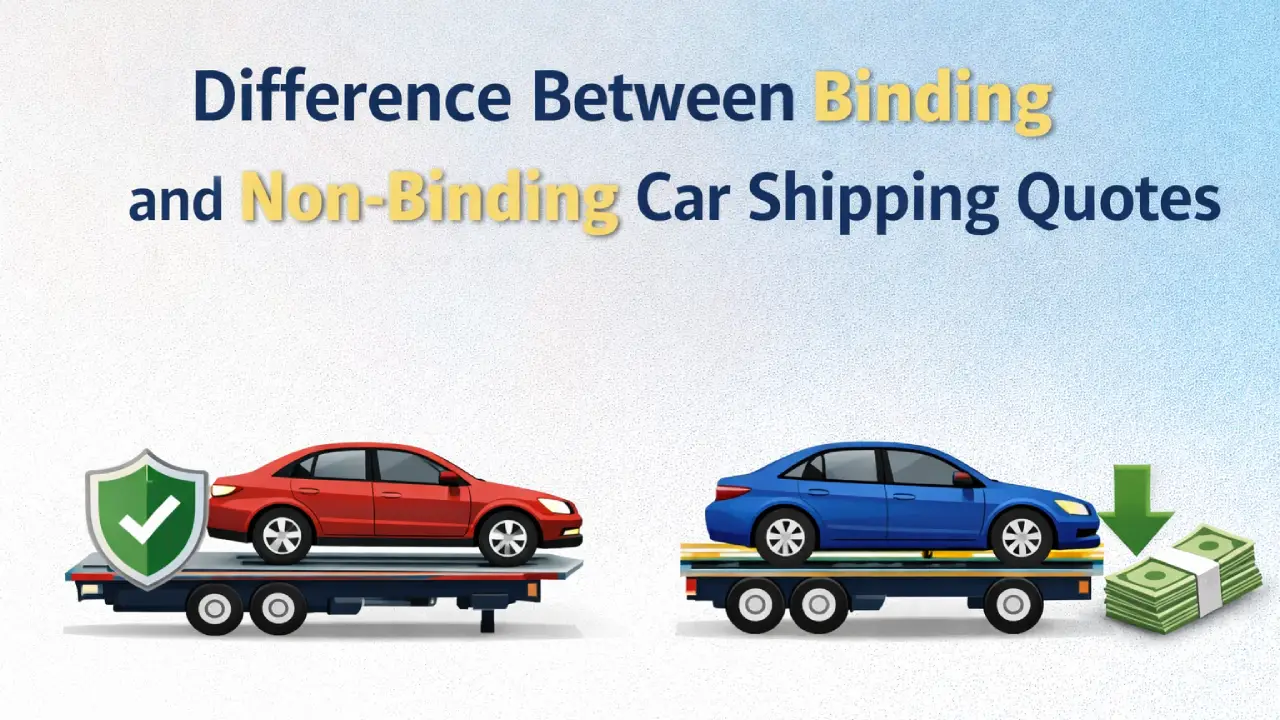
A binding car shipping quote is a written contract that fixes your final price at the agreed amount. The carrier cannot charge you more at delivery regardless of fuel fluctuations, route changes, or demand spikes that occur after you book. A non-binding quote is an estimate only. The carrier can adjust the final charge based on conditions at the time of pickup or delivery, and there is no legal ceiling on how much the price can increase unless one is explicitly written into the agreement.
In practical terms, a binding quote of $1,200 to ship your vehicle from Chicago to Dallas means you pay $1,200 at delivery. A non-binding quote of $1,200 for the same route might result in a final bill of $1,350 or $1,450 if the carrier applies a fuel surcharge, if your vehicle requires special loading due to undisclosed modifications, or any other reason occurs.
What Is a Car Shipping Quote, and Why Does the Type Matter?
A car shipping quote is a written estimate of what a broker or carrier will charge to transport your vehicle from an origin to a destination on a specific timeline. It accounts for variables including route, transport type (open vs. enclosed), vehicle size, operability, and seasonal demand.
What many shippers don’t realize is that the quote type determines whether the number you’re given is the number you’ll pay. Confusing the two is one of the most common sources of billing disputes in the auto transport industry. Carriers are not required to offer binding quotes, and brokers who facilitate transport don’t always make the distinction clear in the initial paperwork.
Recommendation: Read our guide on how to obtain and compare car shipping quotes. It explains how to request written estimates and verify licensing.
What Is a Binding Car Shipping Quote?
A binding car shipping quote is a contractual guarantee of the final price. Once a carrier or broker issues a binding quote and you accept it, they cannot charge you more than the agreed amount. If the vehicle you described at booking is the vehicle that’s loaded on the truck, the price is locked.
Binding quotes are typically based on a documented assessment of your vehicle: make, model, year, dimensions, operability status, and any modifications that affect loading. Because the carrier commits to a fixed price, they account for expected fuel costs, route logistics, and seasonal rate fluctuations upfront. You absorb no pricing risk after signing.
Important caveat: If you request additional services after booking — enclosed transport when you originally quoted open, or expedited delivery — the carrier can issue an amended quote. The binding guarantee applies to the original scope of service, not to scope changes.
What Is a Non-Binding Car Shipping Quote?
A non-binding car shipping quote is an estimate, not a guarantee. It represents the carrier’s best projection of cost based on the information available at the time of booking, but the final bill can differ from that figure.
In household moving, non-binding estimates adjust based on the actual weighed shipment. Car shipping pricing is less weight-dependent but still subject to revision. With a non-binding quote, carriers can adjust the final price based on fuel surcharges applied after booking, route changes due to driver availability, additional handling for an inoperable or oversized vehicle discovered at pickup, or seasonal demand spikes in high-volume corridors.
Non-binding quotes are common in the spot market. It is a system where brokers post loads to a carrier network and accept bids. When you request a quote through a broker, and they give you a “ballpark” or “estimated” figure, you’re almost certainly receiving a non-binding number. Some brokers use artificially low non-binding estimates to win the booking, with the understanding that the carrier will revise the price upward once your vehicle is already in the queue.
Binding vs. Non-Binding Car Shipping Quote: Detailed Comparison
The table below covers every meaningful dimension of the difference between binding and non-binding car shipping quotes — from pricing mechanics to consumer risk and practical use cases.
| Feature | Binding Quote | Non-Binding Quote |
|---|---|---|
| Price guarantee | Yes — locked at signing | No — final price may vary |
| Price can increase after booking | No | Yes |
| Price can decrease after booking | No, you pay the agreed amount | Yes, if costs come in lower |
| Vehicle inspection required | Yes — detailed assessment upfront | General description sufficient |
| Written contract required | Yes — mandatory | Yes, but less enforceable on price |
| Budget predictability | Great with no surprises | Low to moderate — risk of overrun |
| Risk of bait-and-switch pricing | None | Moderate — common with low-ball quotes |
| Scope changes affect price | Yes — amendment required | Yes — added to final bill automatically |
| Useful for high-value or classic cars | Yes — strongly recommended | Not advisable — too much price exposure |
| Useful for standard vehicles | Yes — provides cost certainty | Yes — offers initial pricing flexibility |
| Common with brokers | Less common — requires commitment | Very common — standard broker practice |
| Common with direct carriers | Yes — more reliable guarantee | Yes — used in spot market bookings |
| Payment is due at delivery | Agreed amount only | Final calculated cost — can differ |
| Dispute protection if price changes | Strong — contract enforceable | Weak — carrier has pricing flexibility |
| FMCSA written estimate required | Yes | Yes |
| Consumer risk level | Low | Moderate to high |
| Best for tight budgets | Yes | No — too unpredictable |
| Recommended for cross-country shipments | Yes — avoids fuel surcharge disputes | Risky — long routes amplify price variance |
| Seasonal rate changes affect the final price | No — price is fixed | Yes — peak season routes can spike |
The Third Option: Binding Not-to-Exceed Car Shipping Quote
A binding not-to-exceed quote combines the protection of a binding estimate with the potential upside of a non-binding one. The carrier commits to a ceiling price: you will never pay more than the quoted amount. But if actual transport costs come in lower, you pay the lower figure.
This structure is the most consumer-friendly option available in auto transport. It protects shippers who want cost certainty without locking in a number that might overestimate actual costs. Not all carriers or brokers offer this quote type, so ask explicitly when requesting quotes rather than assuming it is available.
Why it matters: Many shippers default to non-binding quotes because they appear cheaper at first glance. A binding not-to-exceed quote addresses the core concern: “What is the maximum I will pay”, without sacrificing the possibility of a lower final price. For most shippers, this is the optimal choice when available.
All Three Quote Types: Side-by-Side Comparison
Use this table to compare binding, non-binding, and binding not-to-exceed quotes across the factors that matter most when booking car transport.
| Feature | Binding | Non-Binding | Binding Not-to-Exceed |
|---|---|---|---|
| Price at delivery | Exactly as quoted | Can increase or decrease | At or below the quoted amount |
| Maximum price protection | Yes — fixed ceiling | No ceiling | Yes — hard ceiling |
| Can you pay less than quoted | No | Yes | Yes — if costs drop |
| Surprise charges risk | None | Moderate to high | None |
| Vehicle inspection required | Yes | General only | Yes |
| Budget certainty | High | Low to moderate | High |
| Best for high-value vehicles | Yes | No | Yes |
| Best for tight budgets | Yes | No | Yes (preferred) |
| Most consumer-friendly | Moderate | Low | High |
| Scope change triggers an amendment | Yes | Reflected in the bill | Yes |
| Carrier availability | Less common | Most common | Selective carriers |
| Recommended for cross-country | Yes | Risky | Yes (ideal) |
FMCSA Rules Governing Non-Binding Car Shipping Estimates
The Federal Motor Carrier Safety Administration (FMCSA) regulates auto transport brokers and carriers operating in interstate commerce.
What the FMCSA Requires for Written Estimates
Under 49 CFR Part 371, brokers must provide a written estimate before transport begins. It must state whether the quote is binding or non-binding, list the services included, show the price or price range, and display the MC number. In disputes, the written agreement controls.
FMCSA Rules Specific to Non-Binding Estimates
There is no federal price cap on non-binding car shipping estimates. Unlike household moving, auto transport does not have a 110 percent limit. Unless a maximum price is written into the contract, the final cost may legally exceed the estimate.
FMCSA Licensing and Verification
All interstate brokers and carriers must hold an active FMCSA authority. Brokers must also carry a seventy-five thousand dollar surety bond. License status can be verified through the FMCSA SAFER system.
What FMCSA Rules Do Not Cover
FMCSA rules regulate licensing, insurance minimums, and written disclosures. They do not control pricing structure or require carriers to offer binding quotes. Your protection depends on the written contract you sign.
When a Non-Binding Car Shipping Quote Actually Changes
Non-binding quotes in auto transport most commonly change under the following circumstances:
- Vehicle condition differs from booking: An inoperable vehicle described as operable at booking requires specialized loading equipment. Carriers charge extra for this, and the revision happens at pickup.
- Dimensions weren’t disclosed: Modified vehicles, lifted trucks, or oversized SUVs can exceed standard carrier bay dimensions and trigger surcharges that weren’t part of the original estimate.
- Route corridor becomes high-demand: Popular routes (e.g., Midwest to Florida in late fall, or any route during peak military PCS season) can see spot rates rise significantly between quote and pickup.
- Fuel surcharges applied after booking: Some carriers include blanket fuel adjustment clauses in non-binding agreements, allowing rate revisions between booking and delivery.
- Pickup or delivery point changes: Shifting from door-to-door to terminal-based service, or vice versa, alters the cost structure.
- Carrier reassignment: When a broker reassigns your shipment to a different carrier.
A binding quote eliminates all of these as variables. Once issued and accepted, none of the above can change what you owe.
Which Quote Type Should You Request? A Practical Guide
The right quote type depends on your vehicle, timeline, and risk tolerance. Use this reference to match your situation to the appropriate option.
| Situation | Recommended Quote Type |
|---|---|
| Shipping a classic, exotic, or high-value vehicle | Binding — removes all pricing ambiguity |
| Standard vehicle, open transport, flexible on cost | Non-binding or binding not-to-exceed |
| Enclosed transport with premium add-ons | Binding — locks in the full service scope |
| Comparing multiple brokers on price | Non-binding for initial comparison; finalize with binding |
| Tight personal budget, need cost certainty | Binding not-to-exceed — best protection |
| Long-distance cross-country shipment | Binding — avoids fuel surcharge disputes |
Red Flags to Watch for in Car Shipping Quotes
Whether binding or non-binding, the quote itself signals the carrier’s reliability. These are the warning signs worth flagging before you sign anything:
- No written quote provided: A verbal estimate — whether described as binding or not — has no legal weight. Get everything in writing.
- Binding quote with no vehicle inspection: A legitimate binding quote requires a documented vehicle description. If a carrier issues a binding quote without asking about your vehicle’s condition, dimensions, or modifications, that guarantee is not credible.
- Non-binding quote with no stated maximum: Some brokers issue non-binding quotes without a cap on how much the price can increase. Ask explicitly: what is the most I could be charged?
- Quote significantly below market rate: An unrealistically low non-binding quote is one of the most common tactics used to win a booking, with the final price revised upward after your vehicle is already in the carrier’s custody.
- No FMCSA registration disclosed: Any licensed auto transport broker or carrier must have an active FMCSA Motor Carrier (MC) number. Verify at the FMCSA’s SAFER system before booking.
- Pressure to sign quickly: Legitimate carriers and brokers allow you time to review a written quote. Urgency tactics are a sign the terms may not hold up under scrutiny.
What to Confirm Before Accepting Any Car Shipping Quote
Regardless of quote type, these are the questions to ask before you commit:
- Is this quote binding or non-binding? Get the answer in writing, in the contract.
- If non-binding, what is the maximum I could be charged?
- What specific conditions could change the quoted price?
- Is the carrier or broker registered with the FMCSA? Verify their MC number.
- Does the quote include insurance coverage, and what are the liability limits?
- If the quote is a binding not-to-exceed, what conditions trigger an amendment?
- Is this the carrier’s own price, or is it subject to a carrier bid process?
How Brokers vs. Carriers Handle Quote Types Differently
Most people booking car shipping work with a broker rather than a carrier directly. Brokers do not transport vehicles. They source carriers through load boards and carrier networks, which adds pricing complexity and makes the binding versus non-binding distinction especially important.
When a broker gives you a quote, they are estimating what a carrier will accept for the job. If they issue a binding quote, they are guaranteeing that price regardless of what the carrier ultimately charges them. If they issue a non-binding quote, the final price depends on the carrier bid that secures the load, which may exceed the initial estimate.
A carrier that contracts directly with you controls its own pricing because it operates the transport. Binding quotes from direct carriers generally carry more certainty since there is no intermediary margin involved.
This does not mean brokers cannot offer binding quotes. Many reputable brokers do. It is simply important to ask clearly whether the quoted price is guaranteed in writing or subject to carrier acceptance.
Frequently Asked Questions
Can a carrier legally increase a binding car shipping quote after I have signed?
Is a non-binding car shipping quote always cheaper?
Does the FMCSA set a cap on how much a non-binding car shipping quote can increase?
What happens if my vehicle condition differs from what was described?
Do all auto transport companies offer binding quotes?
Is a binding not to exceed quote the same as a binding quote?
How does the difference between binding and non-binding moving estimates compare to car shipping?
Bottom Line
The difference between a binding and non binding car shipping quote is the difference between a guaranteed contract and an informed estimate. Both have valid uses, but they carry different levels of pricing risk. A binding not to exceed quote offers the strongest protection when available. A standard binding quote provides reliable budget certainty. Non-binding quotes are best used for comparison shopping rather than finalizing a shipment that requires price certainty.

a4AutoTransport is a group of auto transport researchers and experts that comes in handy for anyone who wants to move their car/vehicle without putting extra miles on the odometer. At a4AutoTransport, We researched over a hundred car shipping companies, interviewed real customers and industry leaders, and collected nearly 500 quotes to find the nation’s best auto transport companies. With our combined 5 years of industry experience and research, we’ll help you find the right car shipper for your budget.